

Another World is Possible...
on a quiet day, you can hear her breathing.

On Sunday afternoon, June 1st, the first city-wide holiday commemorating the Race Massacre of 1921, I attended a packed event at the Greenwood Cultural Center. There we heard from many people who have been involved in various ways with the effort to bring justice, even reconciliation and healing, for that terrible moment in our city’s history. It was a vibrant event, full of energy, the unresolved anger of generations and the enthusiasm of fierce hope.
For the past couple of years, there has been an effort underway called, “Beyond Apology.” Between April & July 2023, community members in Tulsa, OK engaged in conversations around what repair and reparation might look like in Tulsa. It was an intentional conversation to see what the citizens most impacted historically by that event thought were the best resolutions to some of the harms caused. That data was compiled, a report was issued and the previous Mayor then issued the formation of the Beyond Apology Commission, which released its conclusions and recommendations in February.
Other forces seeking Justice for Greenwood were also pushing on the issue from different directions, including the Justice for Greenwood legal work that is seeking remediation for the two remaining known survivors, Mother Fletcher and Mother Randle, and for the generational wealth lost in that attack on Black Wall Street. The city has now responded with a plan called the “Road to Repair.”
In his remarks before he announced the city’s plans to move forward with some of the Commission’s recommendations, Mayor Monroe Nichols, the city’s first black mayor, compelled us to imagine something with him. Imagine, he said, “a city without the Massacre…”
· Imagine if Greenwood would have continued to thrive uninterrupted;
· Imagine what that would have meant for our economy;
· Imagine what it would have meant for outcomes for our children;
· Imagine what it would have meant for public safety and;
· Most importantly, imagine the Trust and faith we would have built in each other over these last 104 years.
“There is not one Tulsan,” he said, “regardless of their skin color, who wouldn't be better off today had the Massacre not happened or if generations before had done the work to restore what was lost. Instead, the Massacre was hidden from history books only to be followed by the intentional actions of redlining, a highway built to suffocate the economic vitality and perpetual underinvestment from local, state, and federal governments.”
We had held a special worship service the same morning for the church’s 75th anniversary and Mayor Nichols was kind enough to take time from his schedule to greet the church at the opening of worship where he said some of the same things, including this appeal to consider how the wound of 1921 has hurt us all. For some, it is the shame of what our ancestors have done and for others the pain of what ancestors bore.
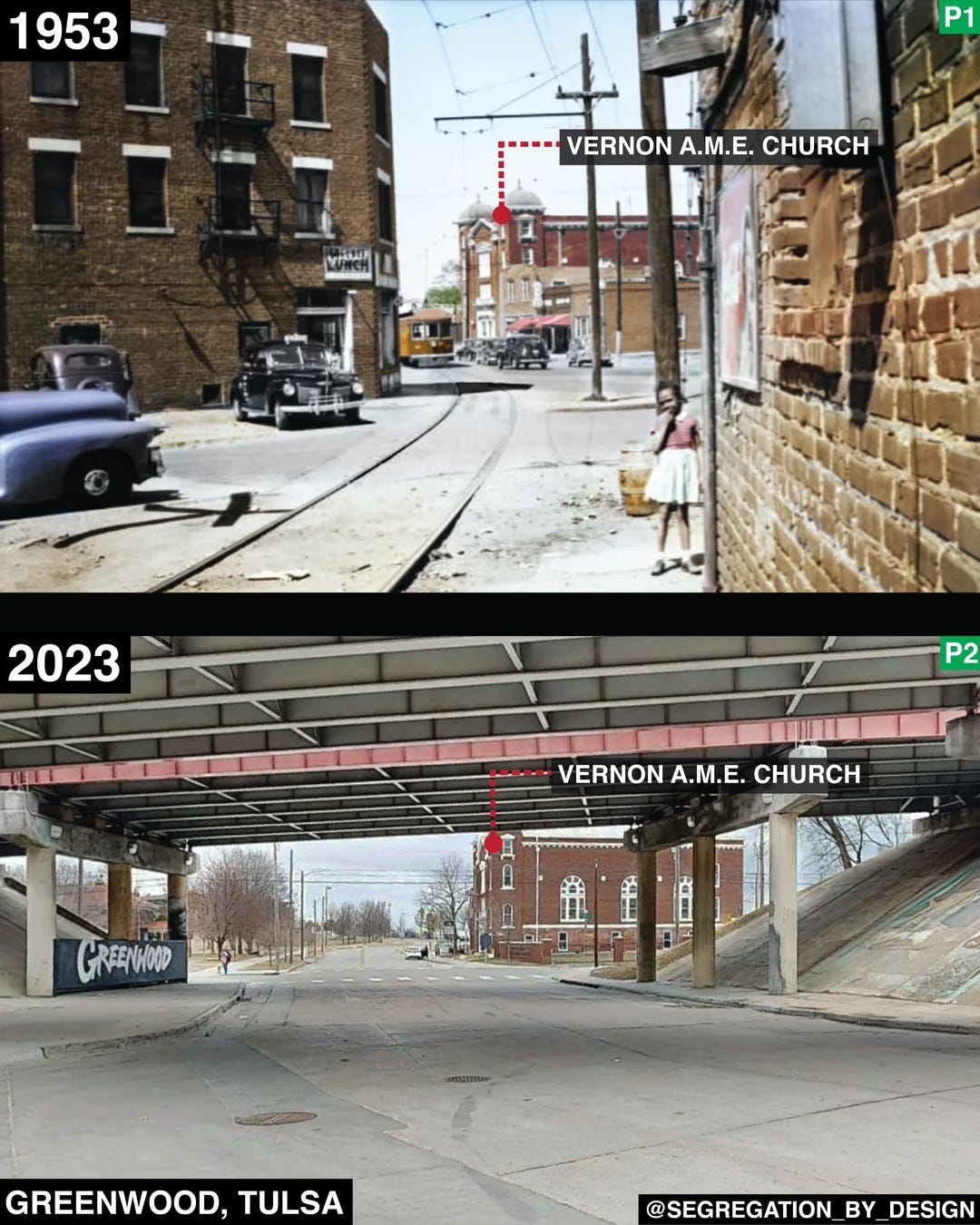
1921 is indeed a mark on us, but Greenwood built back, stronger and more vital than ever, only to be attacked again by less overt means, like redlining, lack of access to capital, and finally the construction of I-244, which cut Greenwood in half and offered, at least in the first years, no off or on ramps. We cannot just cast the blame on a single couple of days in 1921. Greenwood’s dilemma has gone on for much longer, a systemic dismantling of her success. That requires something much more than an apology.
This moment in history may not seem like fertile ground to plant an effort that requires a reframing of our centuries old struggle with racism and systemic injustice, but I had a moment to rethink that on Sunday. Gathered in a room with a wide diversity, I was reminded of the great line from Ahrundati Roy’s poem, “Another world is not only possible, she is on her way. On a quiet day, I can hear her breathing.”[1] I could hear in the words spoken, see in the wide smiles, feel in the handshakes and embrace the kind of spirit that helps us all to reach for a better world.
I’m not naïve, though. I understand that even a well thought out and orchestrated plan will be met with, at a minimum, skepticism. Social media posts already are being met with calls to “let it go,” attacks on the people involved, even outright hostility at the idea itself. It will take courage, focus and tenacity to push through that resistance and make this important change happen. And that work is on all Tulsans to do.
As a friend of mine wrote recently, recounting how she handled pushback for her tireless work on reparations, it is likely that you weren’t here in 1921. You didn’t do the damage; you didn’t experience the terror. But that doesn’t remove our responsibility to address the wound. After all, if you purchase a house and discover that it has foundation damage, you are obligated to fix that damage, even if you didn’t cause it. If we’re going to enjoy the incredible privileges afforded us by our past -- economic, social, constitutional or otherwise – we have to also bear the transgressions.
We seem to be saturated in this cultural idea that life must be always lived in the light of joy and happiness. We must ignore our pain, deny our sins, cast aside the ways that we have missed the mark because to look back, to have regret or guilt is somehow destructive. But that is not what my faith teaches. It teaches that guilt is something that is appropriate when wrongdoing has occurred, and it is mediated by our confession, our efforts at restitution and our absolution from a God whose grace covers all those wounds. That is, when we don’t try and ignore them, or cover them up.
I understand that temptation is mighty, though. As a pastor, I encounter many people whose marriages and families bear the scars of knowing how to relate only transactionally, with little capacity for the vulnerability and courage that it takes to face past mistakes, to be accountable and to work to be better when that always requires change. I see this ethos lived out in the way we build our politics, and, unfortunately, that kind of transactional relating, which erodes empathy, is amplified by social media and screen time, pulling us away from honest compassion and sincere attempts to listen, not to mention the duty we all bear for accountability to one another.
Yet, despite all of this, I am hopeful. I have seen the great outcomes that investment in inclusion and efforts to recognize diversity have produced. I have known how solid a business and social environment is created when we let all ideas flourish. And I know that we grow best individually by growing communally. But this effort will take all of us working together to seek this better world. It will take a willingness to push past the inevitable hurdles, to work hard to make the point that this work is for everyone and to engage the resistance with honesty, sincerity and goodwill.
I’m honestly not sure if I am up to the task, much less anyone else. Yet I feel the Spirit moving us forward, trusting that this is a moment for Tulsa to move “beyond apology” and work for restitution so that grace might indeed help us do the necessary work to heal the wounds of our past and make Tulsa better for all of us.
[1] Ahrundati Roy, War Talk (South End Press, 2003)